
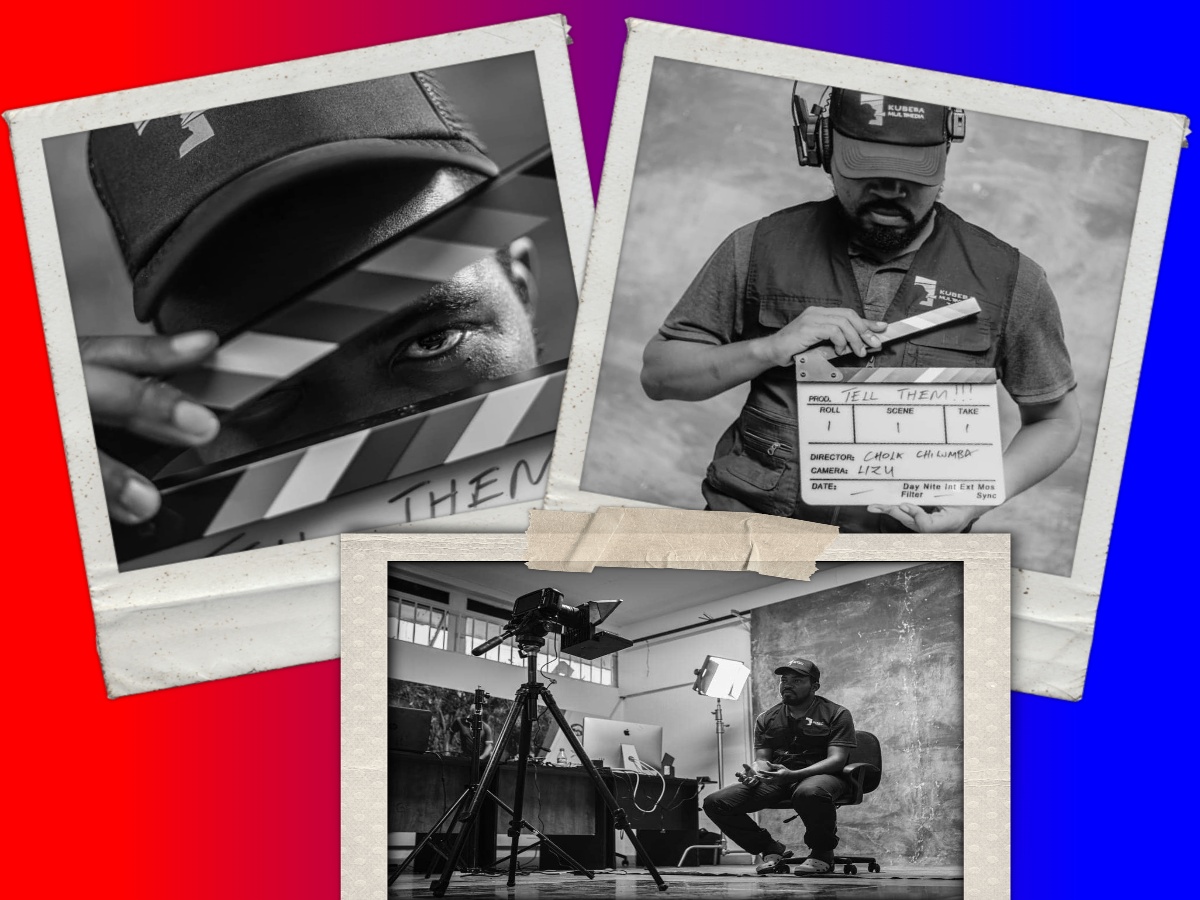
From the plains of Zambia rises a voice woven with rhythm and resolve , Busuma Chola Chilumba, a storyteller who refuses silence.
His journey is a drumbeat of persistence, echoing through film, television, and digital spaces, carrying the pulse of a nation’s untold narratives.
At the helm of Kubeba Multimedia Ltd, Busuma is more than a producer; he is a custodian of memory, a guardian of heritage, and an architect of possibility.
Each frame he crafts is a bridge between past and future, between local whispers and global resonance.
His path is marked by courage: leaving corporate certainty to chase the fire of creation, choosing the uncertain road of vision over the comfort of stability.
In his hands, storytelling becomes both shield and spear , protecting culture, piercing silence, and igniting reform.
This conversation is not just an interview. It is a testament to resilience, a hymn to authenticity, and a call to every creative who dares to dream.
Step into Busuma’s world, where stories are not just told , they are lived, fought for, and carried forward as the heartbeat of Zambia’s creative revolution.
It is a hymn to authenticity, a call to creatives across Africa, and a reminder that the stories we tell shape the worlds we live in.
Step into Busuma’s journey, where each answer carries the heartbeat of Zambia’s creative revolution
In addition to his production work, Busuma is actively involved in industry development and advocacy. He serves as the Chapter Director of the African International Documentary Festival Fund (AfIDFF) Zambian Chapter and is a member of the Zambia Institute of Public Relations and Communication (ZIPRC). Through his work, he continues to champion the creative industry as both a viable economic sector and a powerful tool for shaping identity and driving social change.
The Visionary Journey of CreatepreneurAfrica Zambia’s Busuma Chola Chilumba“
Tell us what drives you? What is your true passion in life?
I’m driven by the desire to transform how Zambian content is created, consumed, and valued. I strongly believe that our creative industry is both a cultural and economic force to reckon with, something that is deeply embedded in Kubeba’s vision.
Zambia has so many unique and compelling stories to share, but we face structural barriers that limit our ability to compete and fully express ourselves. My goal is to become a successful producer within the industry, but beyond that, I’ve found myself increasingly advocating, sometimes even “ranting” about the need for real reform and meaningful change in our creative ecosystem.
What drives me is a strong belief in my ability to create content that is both culturally relevant and commercially viable. I know what I’m capable of, and I believe that, given the right opportunities, I can bring impactful projects to life.
At my core, my true passion is telling stories that matter to me, stories that spark conversation, solve problems, and create value. That belief is central to Kubeba’s mission.
How did you find your passion and how old were you?
My interest in the arts started early. I grew up around creativity. both my parents were artistic in their own ways, but it wasn’t until Grade 12 that my path truly began to take shape.
I remember watching a National Geographic documentary about a pride of lions, beautifully told, deeply emotional. As the credits rolled, I noticed it had been filmed in Liuwa Plains, Western Province, Zambia. I was shocked. I had assumed it was filmed in Kenya or South Africa because of the production quality.
That moment sparked a series of questions:
If this was filmed in Zambia, why wasn’t it told in a Zambian voice?
Who is telling our stories?
And why aren’t we telling them ourselves?
That was the moment everything shifted for me. I decided I wanted to be part of the community shaping and sharing Zambian stories. Around that same time, I joined the drama club, late in my final year, but it reaffirmed that this was where I belonged.
My journey wasn’t linear. After school, I was encouraged to pursue a more stable career path, like accounting. And honestly, sometimes I joke that maybe I should have taken that route. But everything I’ve experienced has shaped me into who I am today.
At university, I immersed myself in practical media work, writing, filming, editing, music, and design. That’s why I identify as a multimedia producer; I’ve developed skills across multiple creative disciplines.
My first real industry experience came through an internship on a production for Zambezi Magic (Fever). Despite the long hours and challenges, I loved every moment of it. That experience confirmed that this was not just an interest; it was my calling.
Later, I faced a difficult choice between continuing in film and taking a more stable corporate role. I chose corporate at the time, driven by responsibility and the need to support my family. But the passion never left.
In 2023, I made the decision to leave my job and build Kubeba Multimedia,because that original question still stayed with me: Who is telling our stories?
What about your passion appeals to you the most?
What appeals to me most is that storytelling is a continuous process of discovery. Every project reveals something new, about people, about society, and often about myself. It allows me to step into different worlds, understand different perspectives, and translate those experiences into something meaningful.
I also value its ability to influence how people think and feel. Stories have the power to shift narratives, challenge assumptions, and inspire action. In a country like Zambia, where many stories remain untold or underrepresented, that power becomes even more significant.
Beyond that, I’m drawn to the dynamic nature of the craft. It sits at the intersection of creativity, strategy, technology, and human emotion. One moment you’re conceptualising an idea, the next you’re solving real production challenges, and then shaping how audiences will receive it. That balance keeps me engaged and constantly evolving.
Most importantly, it gives me a sense of purpose—knowing that what I create can outlive me and contribute to how our culture is documented and understood.
What drove you to make money from your passions?
Initially, it was about independence, the idea that I could use my own creativity and skill to generate income on my own terms. But over time, my perspective evolved into something bigger.
I began to see the creative industry not just as a passion space, but as an economic system that, if structured properly, can create sustainable livelihoods, not just for me, but for many others. That shift in thinking is what pushed me to treat my work more seriously as a business.
Another key factor is the concept of ownership. In the media, the real long-term value lies in intellectual property. The idea of creating projects that can generate revenue beyond their initial release, through distribution, licensing, and adaptation, is something I find very powerful.
So, monetising my passion is not just about making money today, it’s about building assets that can grow over time and contribute to a larger creative economy.
When was the first time you were paid for your passion?
The first time I earned money from my creative work was during my university years, when I worked as a videographer for a media company that occasionally required travel. That income helped me cover some of my school expenses, but more importantly, it shifted my mindset. It showed me that this was not just something I enjoyed; it was something that had real value in the market.
Later, during my early years in broadcasting and production, I started receiving more structured payments for my work. While the amounts weren’t significant at the time, they carried a deeper meaning. They validated my decision to pursue this path and reinforced the idea that storytelling could be both impactful and economically viable.
Those early experiences played a big role in shaping my confidence and commitment to the industry.
What kept you going when you thought about giving up?
If I’m being honest, this has been one of the most challenging periods of my life. Since leaving my job to focus on building Kubeba Multimedia, there have been more setbacks than successes. There have been moments where I’ve questioned everything, my decisions, my direction, and even my ability.
But despite all that, something keeps pulling me back. Sometimes it’s an opportunity that appears at the right moment, sometimes it’s a conversation, and other times it’s just an internal conviction that I can’t fully explain.
I’ve come to realise that for many creatives, the journey doesn’t begin with confidence; it begins with uncertainty. You move forward without fully knowing where the road leads, hoping that clarity will come with time.
What keeps me going is a combination of belief, responsibility, and purpose. I know the weight of the decision I made to leave a stable path, and I understand the risks involved. But I also know that staying would have meant ignoring something that felt fundamentally right to pursue.
Even now, with all the challenges, I don’t regret that decision. It may be difficult, but it’s honest. And that, for me, is enough to keep going.
What motivates you every day to be even more successful?
What motivates me is the desire to build something that goes beyond me, something that has a long-term impact.
Through Kubeba Multimedia, I’m not just focused on producing content; I’m thinking about building systems, platforms, and opportunities that can support other creatives and strengthen the industry as a whole. That bigger picture keeps me grounded, even on difficult days.
I’m also motivated by the idea of representation, seeing Zambian stories take up space on regional and global platforms, told with authenticity and quality. That vision pushes me to keep improving, learning, and refining my work.
On a personal level, there’s also the drive to prove to myself that I can turn this vision into reality. Not out of ego, but out of a need to fully realise my potential.
What do you have to say to all of the people who doubted you?
I understand the doubt. In many ways, it’s justified. The creative industry, especially in our environment, is unpredictable, underfunded, and often misunderstood.
Even I have moments where I doubt myself. So I don’t take it personally when others do.
If anything, doubt has helped sharpen my thinking. It forces me to be more intentional, to question my approach, and to continuously refine what I’m building.
I’m not driven by the need to prove people wrong. I’m driven by the need to build something meaningful. And I accept that there’s a possibility that things may not turn out exactly how I envision them.
But until that point comes, I’ll continue to pursue the vision I believe in. And I trust that, over time, the work will speak for itself.
What advice do you give to aspiring creatives who look up to you?
First, take your craft seriously. Invest time in developing your skills and understanding your voice. But equally important, understand the business side of what you do. Talent alone is not enough. You need structure, discipline, and a clear strategy for how your work creates value. Learn about contracts, intellectual property, distribution, and monetisation. These are just as important as the creative process itself. Secondly, be patient with yourself. Growth in this industry is rarely linear, and it often takes longer than expected. Also, collaborate. The creative industry thrives on relationships, and the people you work with will shape your journey in many ways. And finally, tell stories that matter—stories that are authentic to you and meaningful to your audience. There is space in this industry, but in many cases, you have to create that space yourself.



Leave a Reply